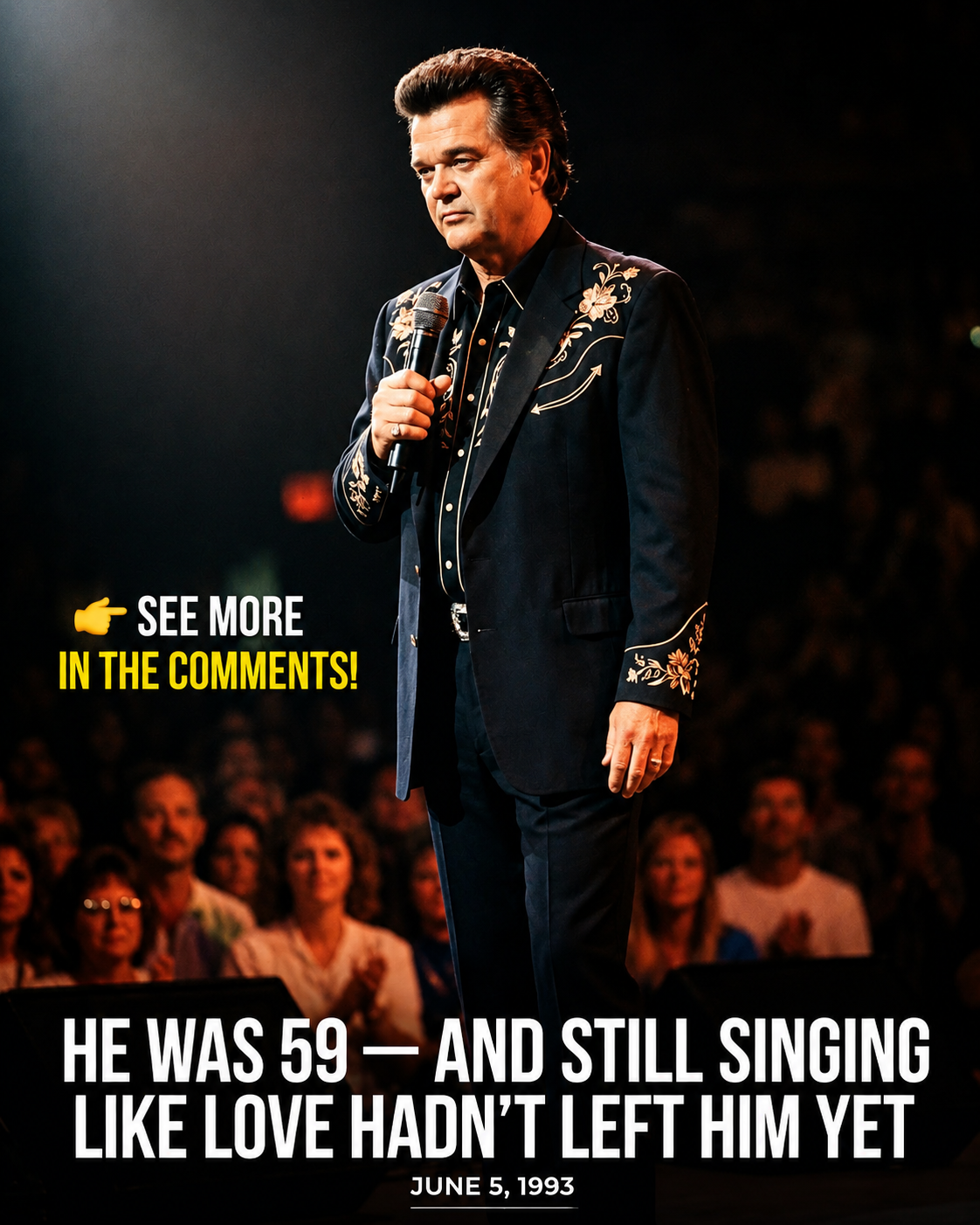
When Conway Twitty’s Voice Suddenly Felt Too Real to Be Just a Song
There are certain artists whose music never feels distant. Their songs don’t simply play through speakers — they become part of everyday life. They sit quietly beside heartbreak, loneliness, late-night reflection, and moments people rarely talk about out loud.
For generations of country music fans, Conway Twitty was one of those rare voices.
When news spread on June 5, 1993, that Conway Twitty had passed away at the age of 59, the shock carried an unusual weight across the country music world. He had not disappeared from public life. He was still touring, still recording, still stepping onto stages with the calm confidence of a man who understood exactly how to turn emotion into melody.
To many listeners, it did not feel like the closing of a legendary career. It felt unfinished — as though country music had suddenly lost a voice that still had more stories left to tell.
A Singer Who Made Heartbreak Feel Personal
By the early 1990s, Conway Twitty was already firmly established as one of country music’s defining artists. Yet his popularity never relied solely on chart success or awards. Fans connected to something more intimate in his music.
He sang romantic songs with unusual sincerity. His performances rarely sounded theatrical or exaggerated. Instead, there was a quiet honesty in the way he delivered lyrics, as though he were speaking directly to one listener instead of an arena full of people.
That quality transformed songs like “Hello Darlin’,” “Linda on My Mind,” and “It’s Only Make Believe” into deeply personal experiences for fans. His music did not chase attention. It earned trust.
Even listeners who had never experienced the exact stories inside his songs often felt understood by them.
Why His Style Felt Different
Many country singers mastered heartbreak songs. Conway Twitty mastered emotional closeness.
His voice carried warmth without sounding fragile. Confidence without arrogance. Pain without self-pity. He understood that the most powerful love songs are often the quietest ones.
That subtle style became his signature. Rather than overpowering audiences, he invited them into the song.
And because of that, listeners formed emotional attachments that lasted decades.
The Silence That Followed the Announcement
Fans who heard the news on country radio still describe the same strange atmosphere surrounding that day.
There was no dramatic interruption. No sensational buildup. Instead, radio stations seemed to pause carefully before speaking his name aloud.
The sadness felt understated — which somehow made it even heavier.
Then came the music.
Stations across the country began playing Conway Twitty songs almost immediately. Not elaborate tribute specials or emotional speeches. Just familiar recordings returning to the airwaves one after another.
Suddenly, songs people had heard hundreds of times sounded completely different.
Familiar Songs Became Something Else
“Hello Darlin’” no longer felt like a classic introduction to a love song.
“It’s Only Make Believe” no longer sounded like nostalgia.
“Tight Fittin’ Jeans” no longer felt tied to a particular era.
Instead, the recordings carried an unexpected emotional weight. Listeners began hearing them not simply as performances, but as lingering pieces of someone who was suddenly gone.
For many fans, it created the unsettling feeling that Conway Twitty still somehow existed inside the radio itself.
One longtime listener later described it as hearing “a conversation continue after the room had already emptied.”
When Love Songs Start Sounding Like Farewells
There is something unique about emotionally honest music after an artist dies.
Lyrics that once sounded comforting can suddenly feel haunting. A soft romantic line can transform into something deeper simply because audiences know there will never be another version sung by that same voice again.
That shift happened immediately with Conway Twitty’s catalog.
His songs were already intimate. After his passing, they became almost unbearably personal for some fans.
The Power of Restraint in His Music
Part of what made Conway Twitty’s music endure was restraint. He rarely overexplained emotions. He left space inside his performances for listeners to place their own memories into the songs.
That space became especially meaningful after his death.
People going through divorce, grief, loneliness, or fading relationships often leaned on his music because it never sounded artificial. His songs understood emotional uncertainty without trying to solve it.
And once the singer himself was gone, those same recordings began carrying a second layer of meaning — one listeners had never expected when they first heard them years earlier.
The Myth of the “Final Goodbye”
Music fans often search for symbolic endings. They want one final performance, one last lyric, or one perfect farewell moment that explains everything.
Real life rarely works that way.
Conway Twitty’s passing came in the middle of a busy career, not after a carefully planned goodbye tour. That reality made the loss feel even more human.
There was no dramatic closing chapter written in advance.
Instead, fans were left revisiting old songs, wondering whether certain lyrics now sounded prophetic simply because they were hearing them through grief.
Maybe there was never meant to be a final message.
Maybe the goodbye was hidden quietly inside the music all along.
The Legacy That Never Fully Left
After June 1993, the world continued moving forward. Country radio evolved. New stars emerged. Musical styles changed.
But Conway Twitty’s voice remained remarkably present.
For many listeners, his songs were never just entertainment. They were companionship during difficult seasons of life. They filled silence during long drives, lonely nights, broken marriages, and moments when people needed comfort without explanation.
That connection did not disappear after his passing.
If anything, it became stronger.
Why His Music Still Feels Immediate
Even decades later, Conway Twitty recordings rarely sound emotionally distant. They still carry the same closeness that originally made fans trust him.
That may be the reason his music continues to resonate across generations.
His songs do not feel trapped in the past. They feel ongoing — like conversations paused temporarily rather than permanently ended.
And perhaps that is the true mark of a timeless artist: the ability to remain emotionally present long after the voice itself has gone silent.
Conclusion
The passing of Conway Twitty was not simply the loss of another country music legend. For many fans, it felt like losing a familiar companion whose songs had quietly helped carry them through life’s hardest moments.
What made the grief so powerful was not only his absence, but the way his music suddenly changed after he was gone. Familiar love songs became reflections on memory, time, and emotional permanence.
Yet even after the silence that followed June 5, 1993, Conway Twitty’s voice never truly disappeared.
His songs still sit beside listeners the same way they always did — patient, intimate, and deeply human.
And that may be why, for so many people, Conway Twitty’s music still does not sound like memory.
It still sounds alive.