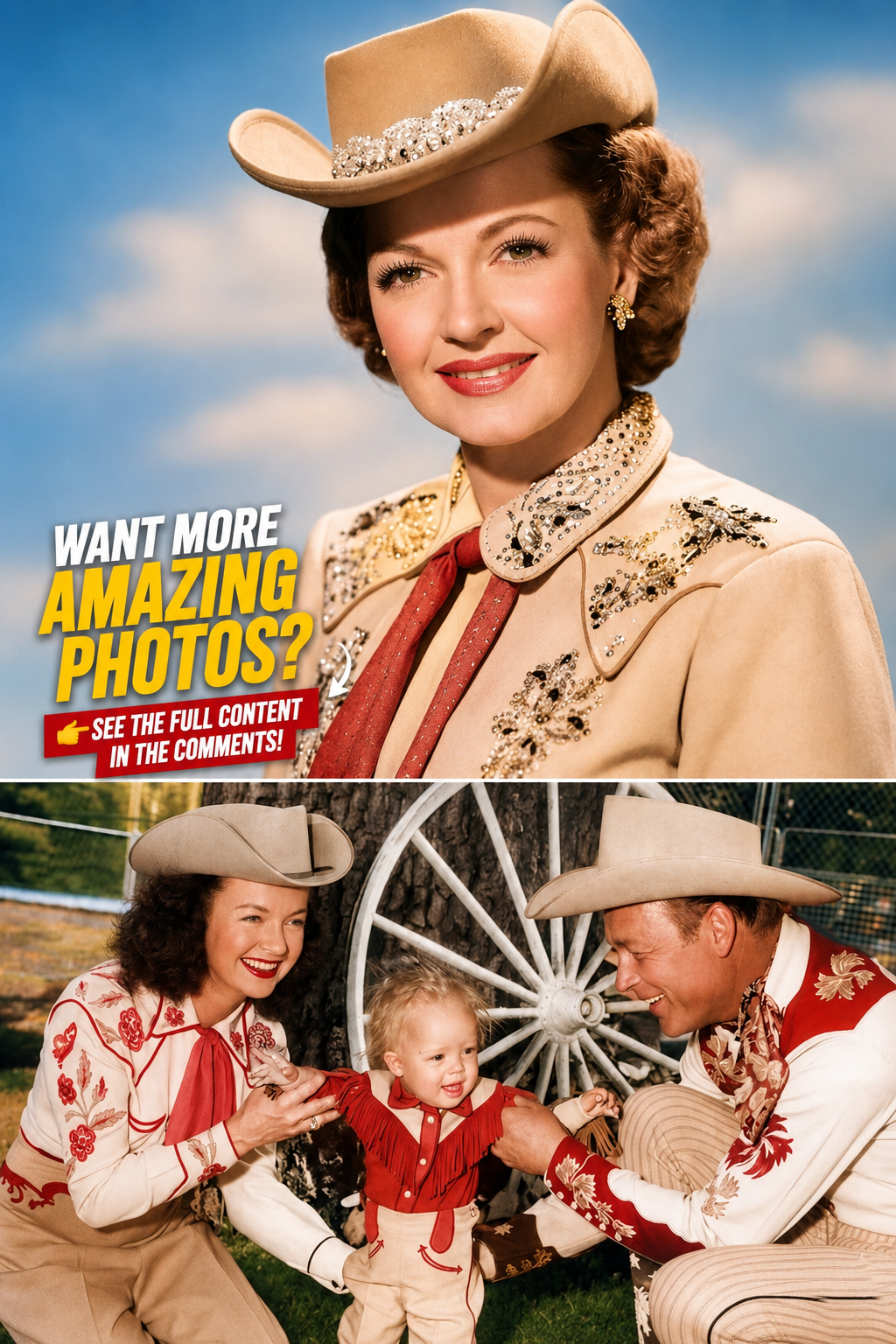
Dale Evans Became a Hollywood Icon—But Her Greatest Legacy Was a Mother’s Courage
Introduction
Long before conversations about inclusion and disability awareness became part of public life, Dale Evans made a decision that quietly challenged the attitudes of an entire era. Known across America as the beloved “Queen of the West,” Dale Evans built a remarkable career through film, music, and television alongside Roy Rogers. Yet the defining moment of her life happened far away from movie sets and applause.
It came in a hospital room, when she was told to walk away from her child.
Instead, she chose love.
A Different Path During a Different Time
In 1950, Dale Evans and Roy Rogers welcomed their daughter, Robin Elizabeth Rogers, into the world. The joy of becoming parents, however, was quickly overshadowed by difficult news: Robin was born with Down syndrome.
At the time, many families faced harsh pressure from doctors and institutions to place children with disabilities in specialized facilities. Parents were often advised not to form emotional attachments, believing separation would make life easier for everyone involved.
For celebrities especially, public image carried enormous weight. Many families chose silence, hiding painful realities from the public eye.
Dale Evans refused to do that.
Rather than sending Robin away, she and Roy Rogers brought their daughter home and embraced her openly as part of their family. In an era shaped by fear and misunderstanding, that choice became an act of extraordinary compassion and quiet defiance.
Love Stronger Than Public Expectations
Today, bringing a child home may sound like the obvious decision for any parent. But during the 1950s, Dale Evans’s choice challenged deeply rooted social beliefs.
She did not treat Robin as a secret.
She did not allow shame to define her motherhood.
And she did not accept the idea that her daughter’s life held less value.
Instead, Dale Evans chose visibility, tenderness, and unconditional love.
That decision would later inspire countless families facing similar struggles behind closed doors.
Grief That Changed Her Life Forever
Tragically, Robin Elizabeth lived only two years. The loss devastated Dale Evans and Roy Rogers in ways no public success could soften.
Many public figures in that era would likely have remained silent, protecting their image while grieving privately. Dale Evans took another path.
Rather than hiding her heartbreak, she transformed it into something deeply personal and profoundly human.
Out of that sorrow came the book Angel Unaware, written from the imagined perspective of Robin speaking from heaven. The book offered readers a deeply emotional reflection on love, loss, and the worth of every human life—no matter how brief.
It was not simply a memoir.
It became a voice for families who had spent years feeling invisible.
Why Angel Unaware Resonated With So Many Families
When Angel Unaware reached readers, its impact extended far beyond celebrity culture. Parents of children with disabilities suddenly encountered something rare for the time: honesty without embarrassment.
Dale Evans spoke openly about grief, motherhood, and the dignity of a child many people would have ignored or hidden away. Her words helped families feel seen during a period when society often offered judgment instead of understanding.
For many readers, the book became a source of comfort and validation. It reminded grieving parents that love does not depend on how long a life lasts or whether a child meets society’s expectations.
Sometimes, the most powerful stories are the ones willing to speak openly about pain.
Building a Legacy Beyond Hollywood
The experience changed Dale Evans forever. In the years that followed, she and Roy Rogers continued expanding their family through adoption, including welcoming children with special needs.
Rather than allowing tragedy to close her heart, Dale Evans used it to deepen her sense of purpose.
Her fame gave her influence, but compassion gave her direction.
She spent decades advocating for vulnerable children and encouraging families to reject shame and choose love instead. Long after the spotlight faded, that message remained one of the most meaningful parts of her legacy.
Conclusion
Dale Evans will always be remembered for her music, films, and iconic partnership with Roy Rogers. But perhaps her greatest contribution was not made on a stage or in front of a camera.
It was the decision she made when the world encouraged her to turn away from her child.
She chose to bring Robin Elizabeth home.
She chose to love without apology.
And through that choice, she helped countless families feel less alone.
That legacy continues to matter far beyond Hollywood.