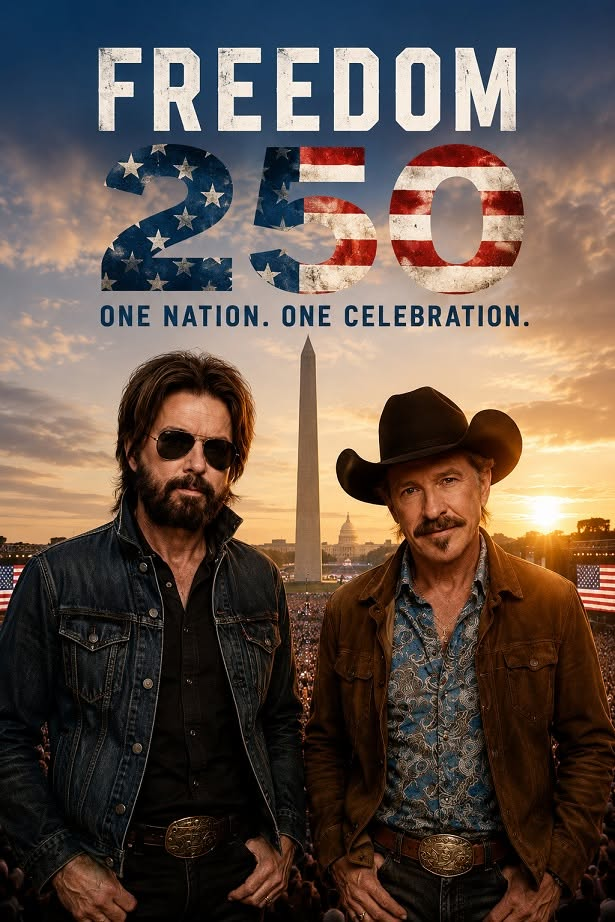
Brooks & Dunn and Freedom 250: Why Fans Believe the Legendary Duo Belongs on America’s Biggest Stage
Introduction
As the United States approaches its 250th anniversary, anticipation is growing for the nationwide celebrations that will honor the country’s history, culture, and future. While fireworks and patriotic ceremonies are expected to take center stage, country music fans have begun asking another meaningful question: should Brooks & Dunn be part of Freedom 250 on the National Mall?
It may sound like a simple idea, but for many Americans, the answer represents far more than choosing another concert performer.
A Career That Mirrors Everyday America
For more than three decades, Kix Brooks and Ronnie Dunn have built a legacy rooted in the experiences of ordinary Americans. Long before they became country music icons, their songs reflected the lives of people in small towns, farming communities, local dance halls, and the highways that connect them all.
Their music never relied solely on chart success. Instead, it became part of countless personal memories, creating a connection that has endured across generations.
Songs That Tell the Nation’s Story
Many of Brooks & Dunn’s biggest hits capture moments familiar to millions of listeners.
“Boot Scootin’ Boogie” celebrates the excitement of a weekend after days of hard work. “Red Dirt Road” explores growing up, learning from mistakes, and appreciating where you came from. “My Maria” continues to fill dance floors with joy decades after its release.
Perhaps no song speaks more directly to a national celebration than “Only in America.” Released well before today’s increasingly divided political climate, the anthem focused on hope, opportunity, and the belief that anyone can pursue the American dream.
Its message remains just as meaningful today.
Why Fans Believe They Fit Freedom 250
Freedom 250 is expected to showcase artists from many musical styles and generations, reflecting the diversity of the nation’s history. Yet supporters argue that Brooks & Dunn bring something especially unique to the celebration.
Their music bridges generations while remaining deeply connected to traditional American values.
Authenticity.
Hard work.
Humility.
Pride in community.
These qualities cannot be manufactured overnight. They have been earned through decades of consistently connecting with audiences who see pieces of their own lives reflected in every performance.
More Than Honoring Two Country Legends
A Freedom 250 appearance would represent more than recognition for a successful career.
It would celebrate the people whose stories inspired the music.
The factory employee finishing another long shift.
The military family separated by duty.
The farmer continuing a family tradition.
The young couple enjoying a Saturday night dance.
The grandparents who still remember hearing Brooks & Dunn on road trips during the 1990s.
Each of those stories forms part of America’s larger identity.
A Celebration That Welcomes Every Voice
No single artist can represent an entire nation, and Freedom 250 will almost certainly feature performers from many genres. That diversity is exactly what such a historic event deserves.
Even so, Brooks & Dunn occupy a rare place in American music. They have successfully connected rural communities, suburban audiences, and mainstream country fans without losing the authenticity that first earned their loyal following.
Their influence reaches far beyond record sales or awards—it lives on through songs that continue to unite listeners of different ages and backgrounds.
Conclusion
Brooks & Dunn have little left to prove. Their place in country music history is already firmly established.
The real discussion is whether America’s 250th birthday would feel complete without the voices that have spent decades celebrating the people, places, and values that define the country.
If Kix Brooks and Ronnie Dunn were to step onto the National Mall stage and perform “Only in America,” it would be more than another memorable concert.
It would serve as a powerful reminder that some songs become woven into a nation’s shared story—and that the artists who created them still have an important role to play as America celebrates its next historic chapter.