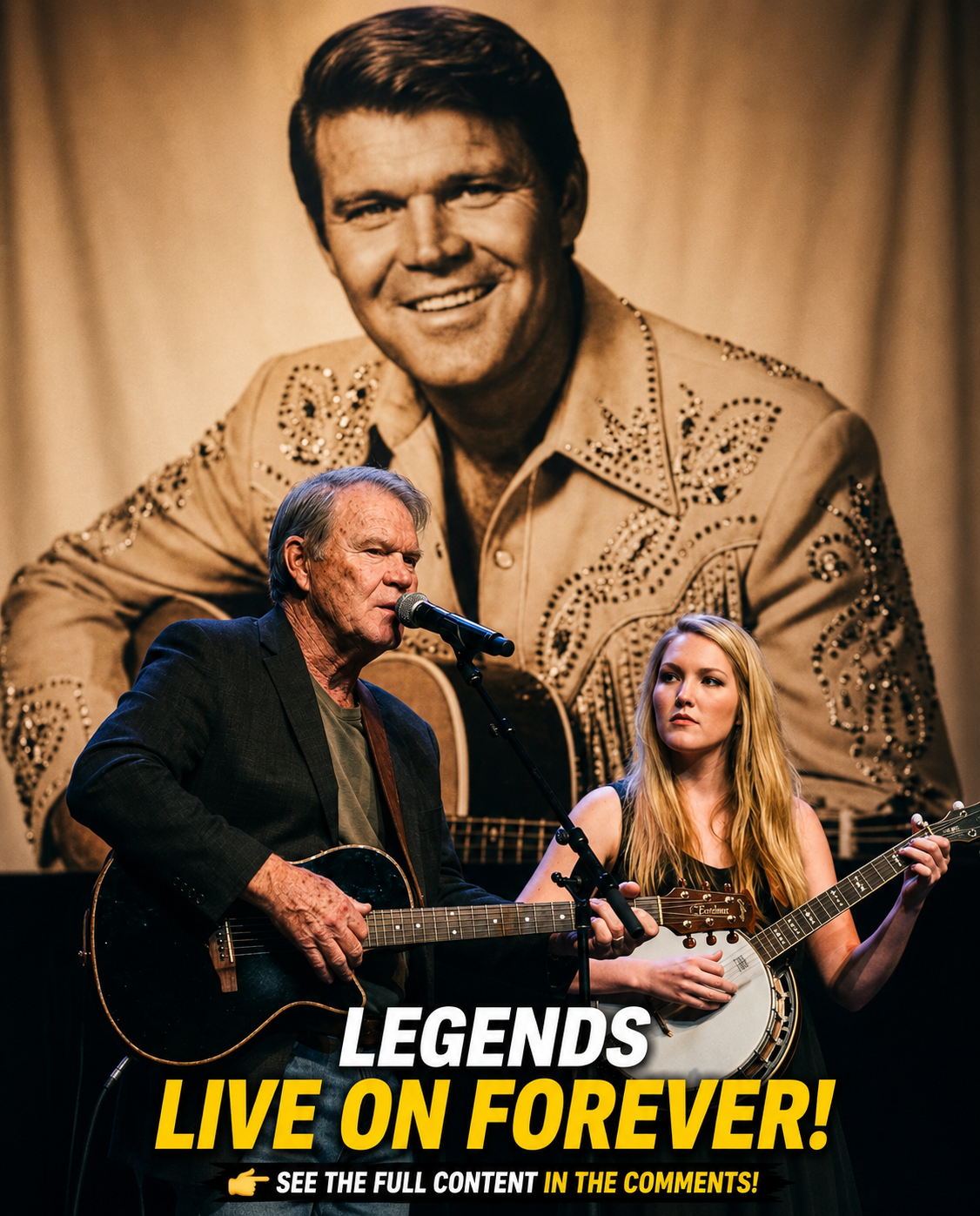
When Ashley Campbell Helped Her Father Finish the Song
Introduction
Some performances are remembered for perfect vocals or unforgettable stage production. Others stay in people’s hearts because they reveal something deeply human. That was the case during Glen Campbell’s final tour, when audiences witnessed not only the legendary artist behind “Rhinestone Cowboy,” but also the quiet strength of a daughter standing beside her father through one of the hardest chapters of his life.
In 2011, after being diagnosed with Alzheimer’s disease, Glen Campbell made a decision that surprised many people around him. Instead of quietly stepping away from the spotlight, he chose to return to the stage one last time. What followed became far more than a farewell tour. It became a powerful story about music, family, courage, and love that continues to touch fans years later.
A Farewell Tour Unlike Any Other
For decades, Glen Campbell had been one of country music’s most beloved voices. Songs like “Rhinestone Cowboy,” “Wichita Lineman,” and “Gentle on My Mind” helped define an era of American music and earned him generations of loyal fans.
But by the time the Goodbye Tour began, everything had changed.
Earlier that year, Glen Campbell publicly revealed that he had been diagnosed with Alzheimer’s disease. The announcement shocked fans around the world. Many assumed the singer would retire immediately to focus on his health and privacy. Instead, he chose to face the future in the place where he had always felt most alive — on stage, guitar in hand, surrounded by music.
The tour quickly became emotional for everyone involved. Fans were not simply attending concerts anymore. They were witnessing a living legend continue to perform while fighting a disease that slowly steals memory itself.
Every show carried a sense of urgency, vulnerability, and honesty.
Ashley Campbell’s Quiet Role Beside Her Father
Standing only a few feet away during those performances was Ashley Campbell, Glen Campbell’s daughter.
At just 24 years old, Ashley joined the band as a banjo player, but her role became much larger than that. Night after night, she stayed close to her father, watching carefully for the moments when confusion appeared or lyrics suddenly slipped away.
Some evenings were smooth. Glen Campbell smiled, joked with the audience, and played with the same charm fans had loved for decades. His guitar still seemed like a natural extension of himself, and for brief moments, it felt as though nothing had changed.
Other nights were more difficult.
There were times when Glen Campbell would pause in the middle of a song, searching for words that once came effortlessly. The audience often sensed something was wrong even before it became obvious. Silence would briefly fill the room as the band continued playing softly in the background.
That was when Ashley stepped in.
Without drawing attention to herself, she would gently lean closer and quietly sing the next line near her father’s ear. She never interrupted the performance or tried to take control of the moment. Instead, she offered support with incredible patience and tenderness.
It was subtle, almost invisible at times, but deeply moving for those who noticed.
The Emotional Weight of “Rhinestone Cowboy”
Among all the songs performed during the tour, “Rhinestone Cowboy” carried perhaps the greatest emotional impact.
For millions of fans, the song represented Glen Campbell himself — resilience, loneliness, perseverance, and hope wrapped into one unforgettable melody. It had followed him through the highest points of his career and became one of the defining songs of country music history.
So when he occasionally struggled to remember the lyrics during live performances, the moment felt heartbreaking in a way that words could barely describe.
Here was a man who had sung the song thousands of times over several decades, now fighting to hold onto lines that once lived permanently in his memory.
Beside him stood Ashley Campbell, helping him continue.
What made these performances unforgettable was not technical perfection. It was the love visible between father and daughter. Audiences were watching someone help carry another person through a deeply personal battle in front of thousands of strangers.
Ashley was not simply assisting with lyrics. In many ways, she became her father’s memory when he could no longer fully rely on his own.
151 Nights of Strength and Determination
The Goodbye Tour eventually stretched across 151 performances, an achievement that felt remarkable considering the circumstances.
Each concert demanded enormous emotional energy from everyone involved. Glen Campbell had to remain focused through the growing effects of Alzheimer’s while still delivering performances for audiences who came to celebrate his music one final time.
For fans, the concerts became opportunities to say goodbye and express gratitude to an artist who had soundtracked so many lives.
For Ashley Campbell and the family, however, the experience was far more personal.
Ashley was not just performing music each night. She was watching her father slowly change in front of the public while trying to stay composed enough to support him. She had to remain alert for missed lyrics, moments of uncertainty, or signs that he needed help — all while continuing to play professionally beside him.
That kind of strength rarely seeks attention.
It happens quietly, through patience, presence, and love.
Why These Performances Still Matter Today
Years later, people still talk about Glen Campbell’s final tour not only because of the music, but because of the humanity audiences witnessed on stage.
There was sadness in those concerts, but there was also extraordinary dignity.
Glen Campbell did not hide from his illness. Instead, he faced it openly in front of the people who had supported him throughout his entire career. He continued performing because music remained one of the strongest connections he still had to himself and to the world around him.
And beside him was Ashley Campbell — not trying to replace him, not trying to overshadow him, but simply helping her father finish the songs he loved.
That is what continues to resonate with so many people today.
The story was never only about Alzheimer’s disease. It was about what remains when memory begins to fade. Music remained. Family remained. Love remained.
Conclusion
The Goodbye Tour became much more than a farewell to a legendary career. It became a rare and deeply emotional portrait of devotion between a father and daughter facing an impossible challenge together.
While audiences came to hear the timeless songs of Glen Campbell, many left remembering something even more powerful — the quiet moments when Ashley Campbell gently helped her father continue singing.
Those performances reminded the world that even when memory weakens, human connection can remain incredibly strong.
And perhaps that is why the story still moves people today: because beneath the lights, the applause, and the music, it revealed something universal about love, loyalty, and standing beside someone until the very last note.