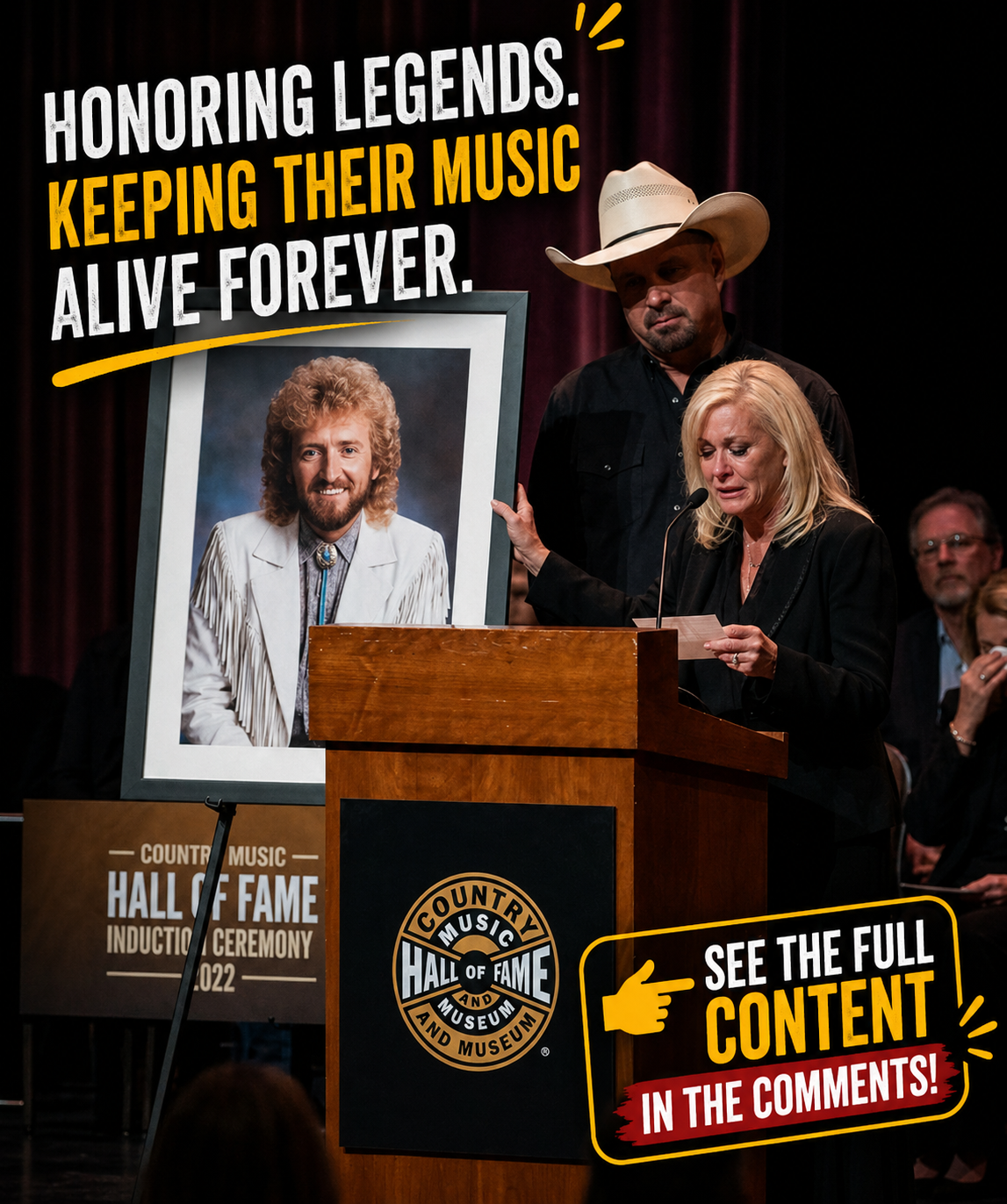
“KEITH SHOULD HAVE BEEN HERE FIRST.” That’s the quiet truth that still echoes through country music history. 👉 Click the link to read the full story: Back in 2012, when Garth Brooks was told he’d be inducted into the Country Music Hall of Fame, he didn’t celebrate. He hesitated. Then he pushed back — not for himself, but for someone who wasn’t even alive to hear it. A man gone for over two decades: Keith Whitley. Garth didn’t see it as humility. He saw it as unfinished business. To him, Keith wasn’t just another name in country music — he was the missing link. The voice that bridged legends like Merle Haggard and George Jones to an entirely new generation. Without Keith Whitley, that explosion of talent in the late ’80s and early ’90s might never have happened. No Garth. No Alan Jackson. No Clint Black. No Travis Tritt. Just a different story altogether. Whitley’s rise was fast, almost too fast. Five consecutive No. 1 hits. A voice that didn’t just sing heartbreak — it lived inside it. There was something fragile in the way he delivered a line, like every word cost him something real. Fans didn’t just listen. They felt him. And then, just as everything was aligning, it stopped. On May 9, 1989, Keith Whitley died of alcohol poisoning at just 34 years old. Two weeks before he was set to receive one of country music’s highest honors — an invitation to join the Grand Ole Opry. It wasn’t just a loss. It was a future erased mid-sentence. For years, his absence became part of his legend. The “what if” that never faded. But recognition didn’t come quickly. It took until 2022 — thirty-three long years — for the Country Music Hall of Fame to finally say his name out loud. And when they did, it wasn’t Keith walking to the stage. It was Lorrie Morgan. She had been only 29 when she lost him. A young wife left behind with memories that never had the chance to grow old. When she stepped up to accept his induction, it wasn’t just a ceremony — it was a moment frozen between love and regret. Because what she shared that night wasn’t polished. It wasn’t distant. It was painfully human. She spoke about the morning she left for Alaska. About the last time she saw him. About the kind of thoughts that don’t show up until it’s too late — the quiet “what ifs” that follow you for decades. The kind no one prepares you to carry. It wasn’t the speech people expected. It was something deeper. Not just about loss — but about time. About how quickly it slips. About how even legends leave behind unfinished conversations, unanswered questions, and moments we wish we could relive just once more. Keith Whitley never got to stand in that spotlight. Never got to hear the applause meant for him. But somehow, his voice never left the room. And maybe that’s the part that stays with people the longest — not the awards, not the charts, but the feeling that he was taken just before the world fully understood what it had.

“Keith Needs to Be in Here Before Me” — A Legacy That Refused to Fade

Introduction

When Garth Brooks received the call in 2012 announcing his induction into the Country Music Hall of Fame, the expected reaction would have been celebration. Instead, there was hesitation—something deeper than modesty.

His response was simple, but it carried weight far beyond the moment:
“Keith needs to be in here before me.”

He wasn’t referring to a contemporary rival or a rising star. He was speaking about Keith Whitley—an artist who had passed away more than two decades earlier, yet remained deeply woven into the soul of country music.


The Voice That Bridged Generations

More Than a Performer

Keith Whitley didn’t just sing songs—he inhabited them. Every lyric he delivered felt less like a performance and more like a confession. There was a vulnerability in his voice that made listeners feel as though they were hearing something deeply personal.

For artists like Garth Brooks, Whitley represented a vital connection between classic country legends such as Merle Haggard and George Jones, and the modern wave that would define the 1990s.

Without that bridge, the evolution of country music might have taken a very different path.


A Rise That Seemed Unstoppable

Chart-Topping Momentum

By the late 1980s, Keith Whitley’s career was accelerating at an extraordinary pace. He achieved five consecutive No. 1 hits—an accomplishment that signaled not just popularity, but lasting resonance.

His songs didn’t fade after their chart run. They lingered, echoing in the hearts of listeners long after the final note.

A Future Already Written

At the same time, the Grand Ole Opry was preparing to extend one of the highest honors in country music—an invitation to join its historic stage.

Everything pointed toward a future that seemed certain.

Until it wasn’t.


The Day Everything Changed

A Sudden Loss

On May 9, 1989, Keith Whitley passed away at the age of 34 due to alcohol poisoning. The news was abrupt, devastating, and left the music world in shock.

Just two weeks later, he was expected to receive his Grand Ole Opry invitation. Instead, that moment became one of country music’s most haunting “what ifs.”

His career didn’t slowly fade—it froze in time, suspended at the height of its promise.


The Influence That Never Disappeared

Carrying the Torch

Even after his passing, Keith Whitley’s presence never truly left. His style, phrasing, and emotional honesty became a blueprint for those who followed.

Artists like Alan Jackson, Clint Black, and Travis Tritt—often referred to as the “Class of ’89”—helped reshape country music in the 1990s.

Yet behind their success was an unspoken truth: each of them carried pieces of Keith Whitley forward.

This wasn’t imitation. It was inheritance.


A Long-Awaited Recognition

Thirty-Three Years Later

It wasn’t until 2022—thirty-three years after his passing—that Keith Whitley was officially inducted into the Country Music Hall of Fame.

By then, his influence had already been felt across generations. The recognition simply gave a formal name to something the industry had long understood.

A Voice for His Story

On that night, it wasn’t Keith Whitley who stood at the podium. It was Lorrie Morgan—his wife, who had lived with both his brilliance and his absence.

Her speech did not follow a polished script. Instead, it reflected on moments—quiet, personal, and deeply human.

She spoke not only of loss, but of reflection—the kind that comes with time, memory, and the weight of things left unsaid.


A Legacy That Still Lives

Keith Whitley’s story did not end in 1989. It continues every time his music is played, every time an artist leans into a lyric with honesty, and every time a listener feels understood through a song.

Garth Brooks’ words in 2012 were not just a statement—they were a reminder.

Some legacies are not measured by time, but by impact.

And even decades later, Keith Whitley still feels like someone who should have walked into that Hall of Fame room first.


Conclusion

Keith Whitley’s journey remains one of country music’s most powerful and unfinished stories. His voice, filled with vulnerability and truth, continues to shape the genre long after his passing.

His legacy lives not only in awards or recognition, but in the artists he inspired and the emotions he left behind in every note.

Perhaps that is what makes his story endure—
not the years he lost, but the timeless connection he created.

You Missed

IT WAS 1979. HE HAD DROPPED TO AROUND 100 POUNDS. MONTHS OF ALCOHOL, PILLS, AND SELF-DESTRUCTION WERE TAKING THEIR TOLL. When George Jones stepped onto the stage at Nashville’s Exit-In for a showcase packed with music insiders, few expected what happened next. He told the crowd that George Jones was finished. Then he proudly introduced a new performer: Deedoodle the Duck. For the rest of the night, he sang in a high-pitched duck voice. The audience sat stunned. They knew the legendary voice that had made George Jones a country music giant. What they heard instead sounded like a cartoon character. Years later, in his autobiography *I Lived to Tell It All*, Jones explained that his mind had become a battlefield. He described two strange voices living inside his head—an elderly man and a young duck named Deedoodle. The two argued constantly, sometimes so intensely that he had to stop his car because he could no longer focus on driving. That night at Exit-In, Deedoodle took control. Jones was painfully thin, his clothes hanging loosely from his body. Standing under the lights, he performed his own songs while sounding like a duck. Witnesses later recalled that many people in the room were emotional. They were not laughing. They were watching a legend fall apart in front of them. The performances continued briefly, but the crowd reactions grew harsher. Boos and insults followed him. Looking back, Jones never tried to hide from that painful chapter. As he later admitted: “I was country music’s most famous drunk and drug addict.” Eventually, Deedoodle disappeared, and the voices faded. But George Jones never erased that part of his story. Seventeen years later, he finally revealed everything—and began with a confession that shocked almost everyone. Have you ever seen video from that unforgettable night? Listen to the song in the 𝗳𝗶𝗿𝘀𝘁 𝗰𝗼𝗺𝗺𝗲𝗻𝘁.

IN 1965, CHET ATKINS TOOK A RISK THAT HELPED CHANGE COUNTRY MUSIC FOREVER. America was in the middle of the civil rights era. Segregation still shaped everyday life, and Nashville was no exception. Then Chet Atkins discovered a singer whose voice immediately stood out. The challenge was simple but harsh: Charley Pride was Black, and the country music industry wasn’t prepared for that reality. Instead of introducing Pride with photos or personal details, Chet carried a demo tape to RCA executives in Los Angeles and let them hear only the music. No pictures. No background story. Just a remarkable voice. The executives were impressed and quickly agreed to offer a recording contract. Only after they made their decision did Atkins reveal who the singer really was. When Pride’s first records reached radio stations, RCA avoided using publicity photos. DJs played his songs for months without knowing anything about his appearance. By the time listeners learned that the smooth voice belonged to a Black man from rural Mississippi, Charley Pride had already earned their admiration. Chet Atkins never made a public statement about breaking barriers. Instead, he let talent speak first. “They believed in the voice before they knew the face. In 1965, that made all the difference.” Not every pioneer changes history from a stage. Some do it quietly, by trusting what they hear. And the private words Chet Atkins shared with Charley Pride during their first meeting stayed with Pride for more than five decades—helping inspire the journey that made him country music’s first Black superstar. Listen to the song in the 𝗳𝗶𝗿𝘀𝘁 𝗰𝗼𝗺𝗺𝗲𝗻𝘁.