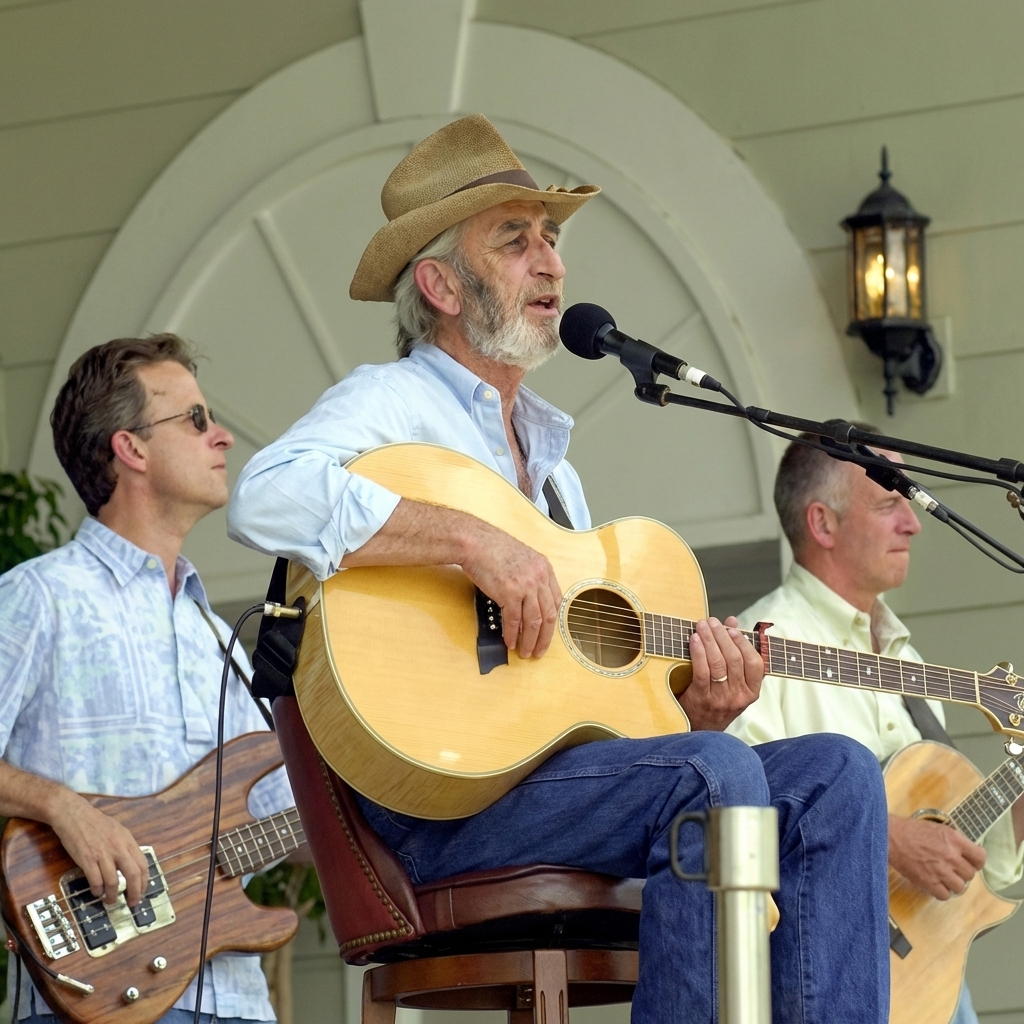
Don Williams: The Gentle Giant Who Needed Only One Listener

In the world of country music, where loud voices and flashing spotlights often dominate, there was a man who built an entire legacy with quiet simplicity. Don Williams, fondly remembered as The Gentle Giant, never chased fame or awards. He didn’t need to. For him, it was never about the numbers, the charts, or the applause — it was always about the music, and the people who truly listened.

Near the end of his life, Williams, who had scored 17 No.1 hits and spent more than five decades in the industry, confided backstage in a moment that startled everyone around him. “If someone out there still plays one of my songs… that’s enough,” he said. No grand speeches, no declarations of legacy — just a quiet acknowledgment of a simple truth. One listener, somewhere in the world, was all he needed.

This quiet statement, almost unremarkable in its modesty, captures the essence of Don Williams’ life and career. While others chased headlines and clamor, Williams found power in restraint. He built a career on calm, steady warmth — a voice that could fill a room without demanding attention, a voice that made each song feel personal and intimate.

A Voice That Spoke Without Shouting

In a genre often defined by big personalities and larger-than-life personas, Don Williams’ approach was revolutionary in its simplicity. He didn’t shout. He didn’t overproduce. Instead, he sang with a gentle authority that made listeners feel as though he were singing just to them.

Songs like “Tulsa Time,” “I Believe in You,” and “Good Ole Boys Like Me” became timeless classics not because they were flashy, but because they were sincere. Listening to Williams was like sitting on a quiet porch with an old friend, sharing stories and memories that linger long after the music ends. His performances didn’t need pyrotechnics or fanfare; they thrived in their intimacy.

For millions across the globe — from the United States to Europe, Australia, and Africa — that calm, steady style became his signature. While other stars fought for the spotlight, Williams crafted songs that seemed to speak directly to one listener at a time, proving that sometimes the quietest voice carries the furthest.

Success Without the Spotlight

By any standard, Don Williams’ career was extraordinary. Seventeen No.1 hits, dozens of charting singles, and a devoted fanbase that stretched worldwide. But the numbers were never what defined him. Those who worked with Williams — producers, fellow musicians, and friends — often described him as the most humble figure in country music. He showed up on time, respected every musician in the room, and performed every song as it was meant to be sung.

There were no extravagant demands, no insistence on attention. Just music, delivered with unwavering consistency. And that consistency, that humility, became his quiet superpower. Williams didn’t need to dominate a stage. His voice alone commanded respect.

The Comfort of Calm

Part of what made Don Williams so beloved was the refuge he offered with every note. In a world often filled with chaos and noise, his songs provided a sense of stability. For some, a Williams ballad played during a long drive home became a companion for reflection. For others, his music underscored family gatherings, quiet nights, or moments of solitude.

Songs like “I Believe in You” or “Lord, I Hope This Day Is Good” were not just melodies — they were emotional lifelines. A gentle voice on the radio could transform an ordinary evening into something meaningful, reminding listeners that calm and kindness can exist, even in fleeting moments.

The Silence After 2017

When Don Williams passed away in September 2017 at the age of 78, the country music world mourned more than the loss of a singer. They mourned the absence of a storyteller who could make every lyric feel like a conversation. Tributes poured in from across the globe, with fans revisiting records and radio stations honoring the classics that defined his career.

For a moment, it felt as though the entire community paused together. The stage went quiet. But even in silence, Williams’ presence lingered. His music, gentle and unassuming, refused to fade.

The Legacy of One Listener

Don Williams’ true legacy isn’t measured by charts, awards, or sold-out venues. It is measured by moments — the listener who presses play in a quiet room, the teenager discovering “Tulsa Time” for the first time, the adult revisiting “Good Ole Boys Like Me” and feeling transported back to a simpler moment in life.

Somewhere tonight, somewhere in the world, someone is still pressing play on a Don Williams song. And in that small, intimate act, his spirit lives on. Not under a spotlight. Not on a stage. Just as he wanted: as a voice, reaching one listener at a time.

“If someone out there still plays one of my songs… that’s enough.”

In an era obsessed with virality, millions of views, and fleeting fame, Williams reminds us of a profound truth: it’s not the crowd that matters, but the connection. The quiet bond between a singer and a listener. The music that continues to live long after the applause has ended.

Don Williams didn’t need noise. He didn’t need recognition. He only needed someone who cared enough to listen — and in doing so, he became immortal.

You Missed

GEORGE JONES’ FIRST RECORD DIDN’T ARRIVE LIKE THE BEGINNING OF A LEGEND — IT SOUNDED LIKE A SHY 22-YEAR-OLD TRYING TO FIND HIS VOICE INSIDE A SMALL TEXAS ROOM. The song was called “No Money in This Deal,” a title George Jones had written himself. At the time, it may have sounded almost playful. Years later, it felt strangely perfect. There was no fancy Nashville studio. No bright lights. No big-name producer waiting to crown him country music’s next great voice. It was recorded in Jack Starnes’ home studio, a rough little setup where the walls were covered with egg crates and the soundproofing was so poor that passing trucks could interrupt a take. George was only twenty-two, recently out of the Marines, and still chasing the sounds of the singers he admired most. He leaned toward Lefty Frizzell, Hank Williams, and the country heroes who had shaped him before he ever shaped anyone else. There was no money in that room. No fame. No promise that anyone would remember the record. Just a nervous young man, a fragile recording session, and a voice that had not yet become “the Possum.” That is what makes the story so powerful now. The first time George Jones stepped toward history, he was not fully himself yet. He was still borrowing pieces of other voices, still learning what his own pain could sound like. And one day, that uncertain young singer would become the voice that made millions of hearts ache. Listen to this song in the 𝗳𝗶𝗿𝘀𝘁 𝗰𝗼𝗺𝗺𝗲𝗻𝘁.

BEFORE CONWAY TWITTY BECAME THE VOICE THAT COULD BREAK HEARTS WITH “HELLO DARLIN’,” HE WAS JUST A MISSISSIPPI BOY LEARNING WHAT REAL LOVE LOOKED LIKE FROM HIS MOTHER. Long before the fame, the velvet voice, the country classics, and the unforgettable duets with Loretta Lynn, Conway Twitty was Harold Lloyd Jenkins from Friars Point, Mississippi — a child growing up in a poor Southern home where life was never easy. His father worked when he could as a riverboat pilot on the Mississippi, but that kind of work did not always bring steady security. When hard times pressed in, it was Conway’s mother who helped carry the family forward. She was not standing under stage lights. She was not hearing applause. She was simply doing what mothers often do — worrying quietly, working hard, and keeping everyone afloat when the world gave them very little to hold onto. That part of Conway Twitty’s story makes his music feel even deeper. Maybe that is why his love songs never sounded shallow. Behind the smooth voice and romantic lyrics was a boy who had seen love before he ever sang about it. He had seen love in sacrifice, in patience, in strength, and in a mother who refused to let her family sink. Before the world heard “Hello Darlin’,” Conway Twitty may have learned his first love song at home — not from a guitar, but from the woman who showed him what devotion truly meant. Happy Mother’s Day to Conway Twitty’s mother, and to every mother whose quiet strength becomes the first music their child ever remembers. Listen to this song in the 𝗳𝗶𝗿𝘀𝘁 𝗰𝗼𝗺𝗺𝗲𝗻𝘁.

IN 1988, VERN GOSDIN SANG ABOUT A NAME CUT INTO A TOMBSTONE. YEARS LATER, LIFE MADE THAT LYRIC HIS OWN. The song was Chiseled in Stone, but Vern Gosdin did not write it from his own tragedy. He wrote it with Max Barnes, a songwriter who had already lived through a pain no parent should ever know. Max’s eighteen-year-old son, Patrick, had died in a car accident years before. That loss stayed with him quietly, until one day in a Nashville writing room, he gave Vern a sentence that carried all of it. “You don’t know about lonely ’til it’s chiseled in stone.” Vern did not need to shout the line. He never did. They called him “The Voice” because he could break a heart by barely lifting his own. He sang it gently, slowly, and with a kind of sorrow that sounded older than the song itself. In 1989, Chiseled in Stone won CMA Song of the Year. For Vern, success had arrived late, when he was already fifty-five. Standing there, he thanked Max for the words that had come from another man’s grief. At the time, Vern had not yet paid that price himself. Then came January 2002. His son Marty was murdered in Ellijay, Georgia. Marty was forty-three years old. After that, Vern stepped away from singing for a while. And when he finally returned, the people who heard him perform Chiseled in Stone noticed something had changed. He sang it slower. He sang it deeper. He stayed on the word lonely just a little longer than before. And when he reached the line about the tombstone, he often looked down, as if the floor could hold the weight of what the crowd could not see. For fourteen years, people thought they understood that song. After Marty’s death, they realized Vern himself had only been borrowing the pain when he first recorded it. In 1988, he carried Max Barnes’s sorrow. In 2002, he carried his own. Vern Gosdin died on April 28, 2009, in a Nashville hospital. He was laid to rest at Mount Olivet Cemetery, where his name was eventually carved into stone — just like the song had warned. The Voice was silent. But one of the most revealing turns in Vern’s life happened long before the world truly knew him. Back in 1964, while he was in Los Angeles, Vern was offered a place in a band that would soon help reshape American music. He refused. The reason he said no explains more about Vern Gosdin than any award ever could. It explains why, decades later, he could sing Chiseled in Stone as if every word had been waiting for him all along. Listen to this song in the 𝗳𝗶𝗿𝘀𝘁 𝗰𝗼𝗺𝗺𝗲𝗻𝘁.