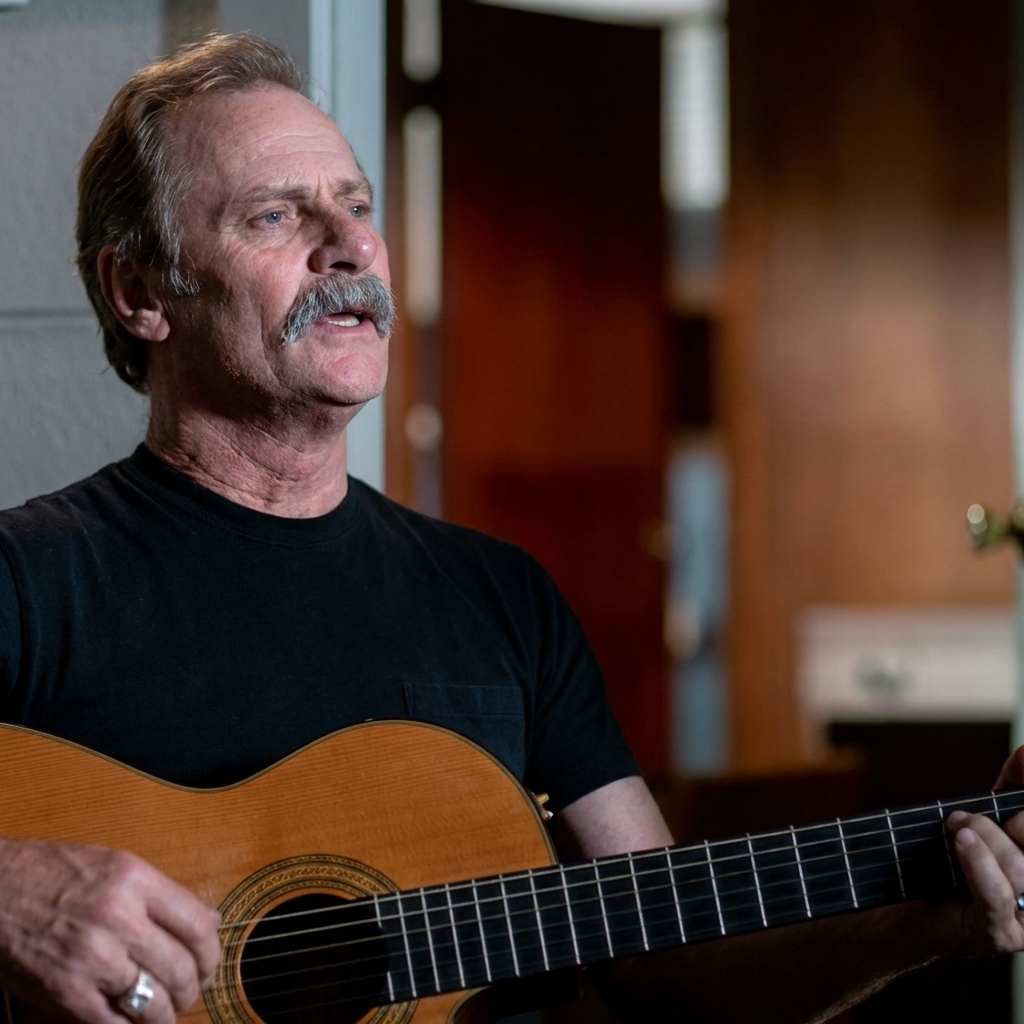
A Silence That Spoke Volumes

“Chiseled in Stone” isn’t just another song in the vast catalog of country classics — it’s one of the genre’s defining heartbreak anthems. Released in 1988 and co‑written by Gosdin and Max D. Barnes, the track was praised for its raw honesty and emotional clarity, earning the Country Music Association’s Song of the Year honor in 1989. What makes it unforgettable isn’t just its lyrical strength, but the way Gosdin’s voice delivers it — trembling with feeling, yet grounded in lived experience, like someone recounting a memory rather than singing a tune.

When that song ended on stage, the crowd wasn’t ready to break the spell. Faces that had followed Gosdin since the rise of his career in the 1970s sat still, glowing under warm lights, connected by the shared experience of a performance that felt like a confession. Gosdin didn’t rush to bow or smile. He simply remained at the microphone, guitar in hand, taking in the audience that had grown older with him.

After a moment longer than expected, he leaned in and spoke, his voice unembellished but full of meaning: “Thank you for letting me do this all these years.”

That simple expression of gratitude wasn’t a career speech. It was a recognition of the bond between an artist and his listeners — a bond stronger than any chart position or award.

The Voice That Didn’t Need Spotlight

In an era increasingly defined by spectacle, Gosdin’s music lived in contrast. There were no smoke machines or synchronized dancers at his concerts. Instead, his presence on stage — often understated and direct — was where honesty lived. When Gosdin sang about loneliness, heartbreak, or regret, he didn’t act the part. He shared it, and audiences recognized something real in the raw emotional layers of his voice.

Songs like “Is It Raining at Your House,” “Set ’Em Up Joe,” and “Chiseled in Stone” weren’t built to chase pop crossover success. They were stories — stories about lives lived, loves lost, and hearts that kept beating despite it all. When Gosdin stepped up to sing them, he wasn’t performing; he was conversing with every listener who’d ever felt the ache he carried in his phrasing.

This sincerity is precisely why fans started calling him “The Voice.” Not because it was loud or flashy, but because it felt like truth — reverberating through each note with a depth that was impossible to ignore.

A Moment That Captured a Lifetime

On that late‑career night, as the last note of “Chiseled in Stone” faded and the audience remained mesmerized, Gosdin created something far more lasting than a typical concert memory. In that charged silence, listeners weren’t waiting for applause — they were reliving the moments his songs had soundtracked in their own lives. They were remembering heartbreaks that mirrored the words they’d just heard. They were seeing reflections of their own journeys in a man who had sung about life’s rugged edges with unrelenting honesty.

There were fans who had driven hours just to see him one more time. Others who had grown older alongside his music, from vinyl to digital playlists. Children who had heard his songs at home and now brought their own children to hear them live. And in one quiet pause, all of that history was alive in the room.

Legacy Beyond the Charts

When Vern Gosdin passed away in 2009 at age 74, he left behind a legacy not measured by trophies, platinum albums, or flashy accolades — though he had earned his share. What stuck with listeners was something more enduring: the feeling that he sang with them, not at them.

In a music world often chasing novelty and flash, Gosdin stood as a reminder that country music’s heart beats strongest where honesty and vulnerability meet. His songs didn’t hide pain — they acknowledged it, embraced it, and sometimes even transformed it into something that felt strangely comforting. When listeners hear “Chiseled in Stone” today, they don’t just hear lyrics — they hear companionship in sorrow, solidarity in heartbreak, and a shared reminder that hard‑earned wisdom is worth hearing.

Why That Night Still Matters

Decades after that night’s performance, the story of Gosdin’s quiet moment on stage still circulates through country music lore not because it was dramatic, but because it was human. In an industry built on applause and charts, Gosdin found something purer: connection. He proved that sometimes, the most powerful moments in music happen not when the final note sounds, but when the audience and artist pause together in silence, feeling what’s true.

You Missed

CONWAY TWITTY SANG MANY LOVE SONGS. BUT ONE OF THEM FELT SO INTIMATE, SO MATURE, AND SO QUIETLY BRAVE THAT IT SEEMED LIKE A PRIVATE PROMISE SPOKEN BEHIND A CLOSED DOOR. By the late 1970s, Conway Twitty already understood something rare. He did not need to sing loudly to own a song. He could lower his voice, bend a phrase gently, and make a simple lyric feel like it was meant for only one heart. People knew that voice. Smooth. Warm. Soft enough to comfort, yet powerful enough to make a room go still. Then Conway Twitty recorded a song that carried a different kind of feeling. It was not about young love rushing toward flowers, moonlight, or a perfect first kiss. This was something deeper. Something older. It sounded like a man looking at the woman who had walked through life with him and saying, “I still see you. I still need you. I still choose you.” That is why the song stayed with people. Conway Twitty made romance feel real — shaped by years, memories, quiet talks, hard seasons, forgiveness, and a love that had not disappeared with age. Some listeners heard a beautiful love song. Others heard something more honest: a grown man singing about desire with tenderness, loyalty with confidence, and passion that time had not taken away. Conway Twitty was not singing about perfect love in a perfect moment. He was singing about love that had survived real life — and still had a flame burning inside it. Maybe that is why so many never forgot it. Some love songs are made for the radio. This one felt like it was meant to stay in the room. Listen to this song in the 𝗳𝗶𝗿𝘀𝘁 𝗰𝗼𝗺𝗺𝗲𝗻𝘁

CHARLEY PRIDE ONLY RETURNED TO LITTLE ROCK FOR A SIMPLE CHECKUP. BUT BY THE END OF THAT VISIT, THE VOICE DOCTORS ONCE WORRIED HE MIGHT LOSE WAS ECHOING THROUGH THE ARKANSAS SENATE. Charley Pride had not come back to Arkansas searching for attention. He was there for a routine medical check on the same voice that had carried him across decades of country music history. Years before, doctors had discovered a tumor on his right vocal cord — frightening news for any singer, and almost unimaginable for a man whose voice had become part of country music’s soul. That checkup brought him back to Little Rock. Then an invitation brought him somewhere unexpected: the Arkansas Senate. Suddenly, Charley Pride was not standing beneath concert lights. There was no band behind him, no roaring arena, no Grand Ole Opry audience waiting for the next song. Just Charley Pride, a microphone, and a room filled with people ready to hear the voice that had survived so much. And then he sang. No law changed because of that moment. No debate was settled. No political victory was claimed. But in a room made for speeches, votes, and decisions, everyone paused for something deeper. They heard a voice that had survived illness, fear, and doubt — and they remembered why Charley Pride had always mattered. The checkup brought him back. The invitation placed him in the room. But the voice made the moment unforgettable. Listen to this song in the 𝗳𝗶𝗿𝘀𝘁 𝗰𝗼𝗺𝗺𝗲𝗻𝘁

GEORGE JONES’ FIRST RECORD DIDN’T ARRIVE LIKE THE BEGINNING OF A LEGEND — IT SOUNDED LIKE A SHY 22-YEAR-OLD TRYING TO FIND HIS VOICE INSIDE A SMALL TEXAS ROOM. The song was called “No Money in This Deal,” a title George Jones had written himself. At the time, it may have sounded almost playful. Years later, it felt strangely perfect. There was no fancy Nashville studio. No bright lights. No big-name producer waiting to crown him country music’s next great voice. It was recorded in Jack Starnes’ home studio, a rough little setup where the walls were covered with egg crates and the soundproofing was so poor that passing trucks could interrupt a take. George was only twenty-two, recently out of the Marines, and still chasing the sounds of the singers he admired most. He leaned toward Lefty Frizzell, Hank Williams, and the country heroes who had shaped him before he ever shaped anyone else. There was no money in that room. No fame. No promise that anyone would remember the record. Just a nervous young man, a fragile recording session, and a voice that had not yet become “the Possum.” That is what makes the story so powerful now. The first time George Jones stepped toward history, he was not fully himself yet. He was still borrowing pieces of other voices, still learning what his own pain could sound like. And one day, that uncertain young singer would become the voice that made millions of hearts ache. Listen to this song in the 𝗳𝗶𝗿𝘀𝘁 𝗰𝗼𝗺𝗺𝗲𝗻𝘁.

BEFORE CONWAY TWITTY BECAME THE VOICE THAT COULD BREAK HEARTS WITH “HELLO DARLIN’,” HE WAS JUST A MISSISSIPPI BOY LEARNING WHAT REAL LOVE LOOKED LIKE FROM HIS MOTHER. Long before the fame, the velvet voice, the country classics, and the unforgettable duets with Loretta Lynn, Conway Twitty was Harold Lloyd Jenkins from Friars Point, Mississippi — a child growing up in a poor Southern home where life was never easy. His father worked when he could as a riverboat pilot on the Mississippi, but that kind of work did not always bring steady security. When hard times pressed in, it was Conway’s mother who helped carry the family forward. She was not standing under stage lights. She was not hearing applause. She was simply doing what mothers often do — worrying quietly, working hard, and keeping everyone afloat when the world gave them very little to hold onto. That part of Conway Twitty’s story makes his music feel even deeper. Maybe that is why his love songs never sounded shallow. Behind the smooth voice and romantic lyrics was a boy who had seen love before he ever sang about it. He had seen love in sacrifice, in patience, in strength, and in a mother who refused to let her family sink. Before the world heard “Hello Darlin’,” Conway Twitty may have learned his first love song at home — not from a guitar, but from the woman who showed him what devotion truly meant. Happy Mother’s Day to Conway Twitty’s mother, and to every mother whose quiet strength becomes the first music their child ever remembers. Listen to this song in the 𝗳𝗶𝗿𝘀𝘁 𝗰𝗼𝗺𝗺𝗲𝗻𝘁.